A R M O U R I E

When times get tough, the tough buckle up. Studs, spikes, metallics, shields, shoulder pads...things seem to be referencing armour. It seems as though since the infamous Loubouitn for Rodarte heels, studs and spikes have been embraced as an embellishment for the modern pallette, with designers experimenting with various arrangements and stud styles, from Alexander Wang's planar approach (as demonstrated by the amazing Wang bag, Mary Kate is carrying below) to Sandra Backlund's knitted comfort armour. It is almost as though those in the know are protecting themselves from the world, and looking fantastic doing so.
This influence, however, is not always so startlingly apparent. While under a scrutinizing gaze, I came to the conclusion that armour, in reality, is really a form of deconstruction. This is no more obvious than when we look at "traditional" armour suits (the kinds your parents have in the corridor at the manor). Limbs are reduced to metal tubes, while elbows and knees are given the luxury of either being exposed of encased in glistening metal pleats, and lets not forget that elegant face grill.
Prada toyed with ideas of deconstruction and emphasis on certain areas of the body visible jockstrap straps (which i guess could be thought of as a kind of sports armour....of sorts?)
, secondary collars (possibly a play on office armour, being a status symbol?) and chest plate/bib, again juxtaposing the primitive nature of armour with fanciful high society. Even more recently they played with studs.
And how could we ever forget the appropriately weathered fabrics Ms Kawakubo sent down runways in Paris in the early eighties in opposition to the decadence of the decade. Perhaps, after so long on an upward climb through the late 90s and first decade of the noughties, a reality check was overdue...but don't worry, it's here now.
Diane Pernet's Hyeres Festival recently saw Simon-Pierre Touissant his collection that explored the struggles of growing up as a boy from a 16 years old until his early to mid twenties. This manifested itself in pure white undergarments beneath playful clothes and pieces of armour varying from full wooden armour suits to perhaps one of the most comforting pieces of armour, a sleeping bag.
At the same festival, Marite Mastina and Rolands Peterkops topped models' heads with oversized helmets of hair. The protection of a fringe.

Robust fortress like, architecture has always had a place in and around cities all over the wolrd, and is similarly symbolic. Used by governing bodies to display strength, heavy, masculine buildings encapsulate the street scapes of our favourite cities. Their walls large planar surfaces of stone provide a feeling of security to those that reside inside their cavernous bellies.
In other examples, singular planar walls provide more private buildings with a distinct sense of separation from busy city streets, allowing the user to feel worlds away by simply passing through a single door way.
Deconstructivism also has it's palce in archtecture as it does in clothing the body. While often taking on a lighter structure and cladding than it's more robust, fortified counterparts, these buildings often appear segmented and somewhat disjointed, at times cubist in nature. unnecessary space is eliminated leaving only the crucial spaces to define the form of the building. Architects such as Peter Eisenman, whose often controversial designs verge on the chaotic, nay for a single axis or coloured line that runs through an entire project restoring some sort of order.
As technology continually progresses, the variety in structural solutions and cladding opportunities continually expands, allowing for freer architectural expression.
Here's for the day of a Backlund clad army inhabiting the Wexner Centre for Arts:


(feel free to ask if you want specifics on any of the images, just as always)

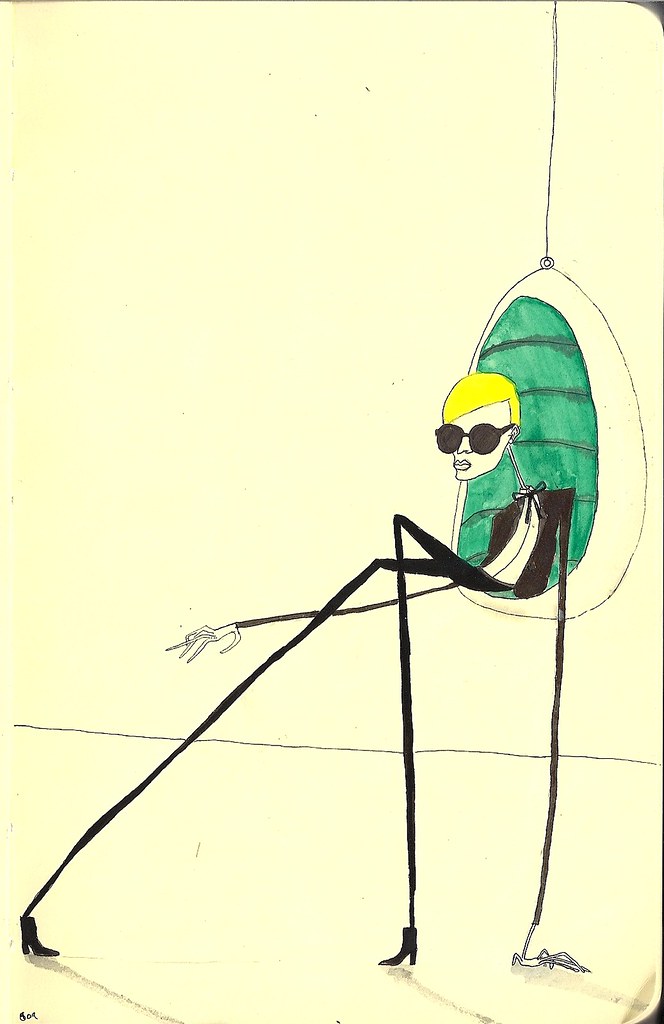
Marvelous Malevolence: Take 2

A little self portrait fuelled by a previous post.
I think i'll start listing my profession as "Disney Villain" on surveys and things...could be fun.

P L E A T S P L E A S E !

Pleats are a clothing detail i have always been exceptionally fond of. A pleated skirt can have such great movement, and the vertical shadow lines are no less than flattering, but it's not something used very often in menswear, or at least not to the same effect as in womenswear. I mean, pleated trousers give a little more volume and room for movement in the leg, but it's nothing like the swish swish of a pleated skirt. Comme Des Garcons lovingly pushed the boundaries forward enough to suggest men layering kilts (a look which i spotted a few people wearing around Tokyo earlier this year), which really should not seem as outrageous as it does, considering kilts are a traditional menswear item.
Traditional Japanese menswear also sees men down extremely wide legged super pleated trousers that look almost like a floor length pleated skirt that flairs out from the waist, again, something that made me gasp in amazement when i saw someone in it walking down the street in Tokyo.
Gareth Pugh's last womensear collection presented a similar pleated bottom that was only done justice in the video presentation.
So i guess what i'm hoping for is a future with more pleats.
Pleats for all.
Flattering pleats.
Moving pleats.
Then i remembered to last semester at uni when i got terribly obsessed with the notion of fabric walls and the permeabiltiy of divides and what constitutes divisor of space, a concept that, i feel, is most elegantly handles by the Japanese, with a tradition of understanding the more subtle qualities of light, and respecting shadow, it's not really very surprising. Architects like SANAA constantly comment on how they are toying with the notion of a divide and how thin/transparent/non existent it can be before no divide is apparent, while others, like Toyo Ito explore the "fluidity of space" to similar effect.
Curtains, as in walls of fabric, are not very often used as architectural features as more advanced systems have been but in place since the old heavy curtains that created insulating pockets of air between the windows of old English manors and their toasty, fireplace heated interiors, or the colourful divides of modernist residences like Rose Seidler house. There are however some stunning examples curtains enhancing and defining the spaces they encompass, providing an ephemeral environment in which the light is diffuse, the walls are fluid, outside sound is muted and only shadows pass through undisturbed.
It is my dream to have a large white room with a dark, heavy wooden table with 6 chairs, sturdy and rectangular, situated in its centre encompassed on all sides by a white translucent curtain onto which 4 movies are projected through out the night, while those present munch and chat until the date changes, and ambient haunting tunes fill the air inside the ghostly barrier.
Here are some images of pleats and curtains, which are really just the big pleated skirts of space, that i hope you will enjoy.